
Embark on a journey to unravel the essence of investment horizon, exploring its pivotal role in shaping financial decisions and strategies. Delve into the realm where time meets finance, guiding individuals towards a secure and prosperous future.
As we navigate through the intricacies of investment horizon, we uncover its profound impact on risk tolerance, investment choices, and ultimately, the realization of financial aspirations.
What is Investment Horizon?
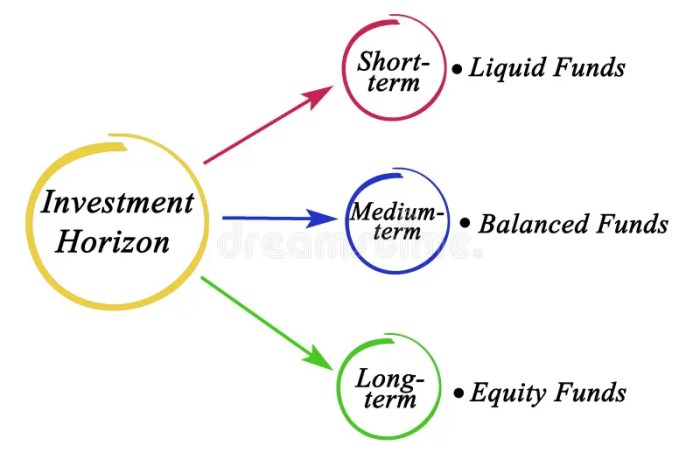
Investment horizon refers to the time period an investor is willing to hold an investment before needing to access the funds. It is a crucial factor in financial planning as it helps determine the appropriate investment strategy based on an individual’s goals, risk tolerance, and time horizon.
Importance of Investment Horizon in Financial Planning
The investment horizon plays a significant role in financial planning as it influences the choice of investment vehicles and the level of risk that can be taken. A longer investment horizon allows for a more aggressive investment approach, while a shorter horizon may require a more conservative strategy to protect capital.
Impact of Investment Horizon on Investment Decisions
The investment horizon directly impacts investment decisions by influencing asset allocation, diversification, and the selection of specific investments. A longer horizon provides more time to ride out market fluctuations and potentially earn higher returns, whereas a shorter horizon may require a more stable and predictable investment approach.
Relationship between Investment Horizon and Risk Tolerance
Investment horizon and risk tolerance are closely related, as a longer horizon typically allows investors to take on more risk due to the potential for higher returns over time. On the other hand, a shorter horizon may necessitate a lower risk tolerance to preserve capital and meet short-term financial goals.
Investment Advice
Seeking professional investment advice is crucial for individuals looking to navigate the complex world of investing. An investment advisor plays a key role in helping clients develop a personalized investment plan tailored to their financial goals and risk tolerance. By leveraging their expertise and experience, investment advisors can provide valuable insights and recommendations to optimize investment decisions.
Importance of Professional Advice
- Professional investment advice can help individuals make informed decisions based on their unique financial situation.
- Advisors can offer guidance on asset allocation, investment selection, and risk management strategies to maximize returns.
- They can provide ongoing monitoring and adjustments to the investment plan to adapt to changing market conditions.
Role of an Investment Advisor
- An investment advisor conducts a thorough assessment of a client’s financial goals, risk tolerance, and time horizon to create a customized investment strategy.
- They help clients navigate the complexities of the financial markets and stay informed about investment opportunities and potential risks.
- Advisors also assist in monitoring and rebalancing the investment portfolio to ensure it remains aligned with the client’s objectives.
Benefits of Investment Advice
- Professional advice can help individuals achieve long-term financial goals, such as retirement savings, education funds, or wealth accumulation.
- By working with an investment advisor, clients can benefit from expert knowledge and insights that can lead to better investment outcomes.
- Advisors can provide peace of mind and confidence in financial decision-making, reducing stress and uncertainty about investment choices.
Investment Banking
Investment banking plays a crucial role in the financial sector, specializing in helping companies raise capital through various methods and providing advisory services for mergers, acquisitions, and other financial transactions.
Key Functions of Investment Banking
- Underwriting securities offerings
- Providing merger and acquisition advisory services
- Facilitating corporate restructurings
- Trading and market-making activities
Differences between Investment Banking and Commercial Banking
- Investment banks focus on capital markets and corporate finance, while commercial banks primarily deal with deposits and loans.
- Investment banks provide services to corporations and institutional clients, while commercial banks cater more to individual customers.
- Investment banks engage in riskier activities like trading and underwriting, while commercial banks have a more conservative approach.
Role of Investment Banks in Capital Markets and Corporate Finance
- Help companies raise capital through debt or equity offerings.
- Provide advisory services for mergers, acquisitions, and other strategic transactions.
- Assist in structuring financial products and managing risks for clients.
Investment Opportunities
Investment opportunities refer to various avenues where investors can allocate their funds with the expectation of earning a return. Evaluating these opportunities based on risk and return is crucial in making informed investment decisions. Diversification plays a key role in maximizing these opportunities by spreading risk across different asset classes.
Types of Investment Opportunities
- Stocks: Investing in shares of publicly traded companies.
- Bonds: Purchasing debt securities issued by governments or corporations.
- Real Estate: Investing in properties for rental income or capital appreciation.
- Mutual Funds: Pooling funds with other investors to invest in a diversified portfolio.
Evaluating Investment Opportunities
- Return: Assess the potential return on investment based on historical performance and future projections.
- Risk: Evaluate the level of risk associated with the investment, considering factors like volatility and market conditions.
- Time Horizon: Determine the time period over which you plan to hold the investment to achieve your financial goals.
Importance of Diversification
Diversification involves spreading investments across different asset classes to reduce risk exposure. By diversifying your portfolio, you can minimize the impact of negative events affecting a particular asset or market segment. This strategy helps in maximizing investment opportunities by balancing risk and return effectively.
Investment Strategy
Investment strategy refers to a plan or approach used to make investment decisions with the goal of achieving specific financial objectives. It involves a set of rules, behaviors, and procedures designed to guide an investor’s selection of investments over time.
Components of Investment Strategy
- Diversification: Spreading investments across different asset classes to reduce risk.
- Asset Allocation: Determining the mix of assets in a portfolio based on risk tolerance and investment goals.
- Risk Management: Implementing measures to mitigate potential losses.
- Research and Analysis: Conducting thorough research to identify promising investment opportunities.
Significance of Aligning Investment Strategy with Financial Goals
Aligning your investment strategy with your financial goals is crucial for achieving long-term success. By setting clear objectives and tailoring your investment approach accordingly, you can ensure that your portfolio is in line with your desired outcomes.
Tips for Developing a Successful Investment Strategy
- Understand Your Risk Tolerance: Assess how much risk you are willing to take on and build your strategy around it.
- Define Your Investment Horizon: Consider your time horizon for investing and adjust your strategy accordingly.
- Stay Informed: Keep up to date with market trends and economic developments to make informed decisions.
- Regularly Review and Rebalance: Monitor your portfolio regularly and make adjustments as needed to stay on track towards your goals.
In conclusion, the concept of investment horizon emerges as a critical compass in the vast landscape of financial planning, steering investors towards informed decisions and fruitful outcomes. Embrace the power of time in your investment journey, and watch your financial goals materialize with strategic precision.
Detailed FAQs
What factors should be considered when determining an investment horizon?
Factors such as age, financial goals, risk tolerance, and investment objectives play a crucial role in defining your investment horizon.
How does investment horizon influence the choice between short-term and long-term investments?
Investment horizon guides the decision-making process by aligning the duration of investments with your financial goals and risk tolerance.
Can investment horizon change over time?
Yes, investment horizon is dynamic and can evolve based on changing life circumstances, financial objectives, and risk preferences.


